The Click That Crashed a Hospital
I flicked the switch, the wards went dark, here’s why your “just reboot it” reflex can kill
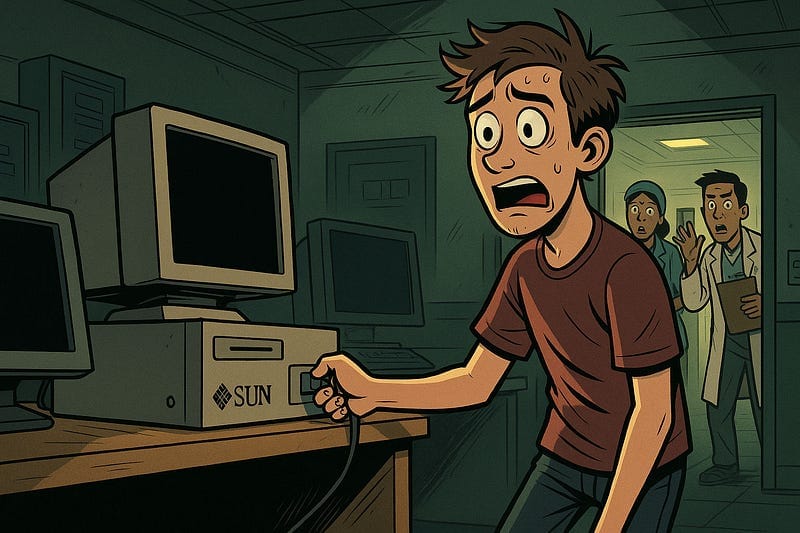
The silence that followed was deafening. Three doctors, two researchers, and the IT manager all stared at me as I whispered the words that would haunt me for decades: ‘I… I turned it off and on.
Let me back up and explain how a frozen cursor led me to crash an entire hospital’s computer system.
During my third year at technical college (HTS), I started my required internship at a hospital. For three weeks, I’d been quietly proud of myself as I developed software to parse brain injury data from accident victims.
The work was critical; the environment was intense, and I was handling it all on Sun workstations (powerful Unix-based systems common in the 90s), a far cry from the PCs I’d grown up with.
But I’d adapted quickly. Linux experience helped. The commands felt familiar. I was getting things done.
I thought I had this figured out.
Then, on a quiet afternoon when I was alone in the IT department, my terminal froze. Completely. The cursor just sat there, blinking mockingly at me. Nothing I typed registered. No response to any keyboard shortcuts.
I stared at the screen for a few minutes, trying everything I could think of. But the terminal was dead to the world.
That’s when I remembered. Sitting right there next to my desk was this pizza box-sized beige unit.
I knew now that these flat, horizontal cases were typical for Sun Microsystems workstations, but at the time, it just looked like a computer.
And like any computer, it had a power switch around the back.
Of course, I thought. When in doubt, restart it.
It had worked a thousand times on every PC I’d ever owned. A computer is a computer, right?
I reached around to find that small switch on the back of the pizza box with the casual confidence of someone who had just solved an obvious problem.
What happened next taught me more about assumptions, systems, and professional humility than any textbook ever could.
Rebooting the system
The screen went black. Good. Boot messages scrolled past. Even better. Then absolutely nothing.
The system hung completely.
I sat there for a moment, puzzled but not yet worried. Maybe it just needed a minute? I’d seen slow boots before.
That’s when I heard the footsteps. Not casual footsteps, the urgent, purposeful kind that makes you instinctively check if you’ve done something wrong.
The first person burst through the door. “Is the server down?”
Before I could answer, two more people rushed in. “I’ve got a neurosurgeon screaming for lab results, why is the server DEAD?”, “My terminal just died!”
“Mine too!”
“What happened to the system?”
Within minutes, my quiet office had transformed into a crisis center. Doctors, researchers, other IT staff, all converging on my desk with the same panicked question: Why couldn’t they access their work?
That’s when the horrible realization hit me like a freight train.
This wasn’t my workstation.
This innocuous pizza box sitting next to my desk wasn’t just serving my terminal.
It was a multi-user Sun server, quietly hosting sessions for dozens of people across the hospital. Doctors analyzing patient data. Researchers running critical computations. IT staff manage the infrastructure.
And I had just pulled the plug on all of them with the confidence of someone rebooting their home PC.
“I… I turned it off and on,” I admitted, my voice barely above a whisper.
The silence that followed was deafening.
The morning after
I spent that evening replaying the moment over and over. How could I have been so careless? So presumptuous?
I’d been handling critical medical data, working in a hospital environment where every system could impact patient care, and I’d treated their infrastructure like my personal computer.
The next morning, I found Rob, the system administrator, already at my desk. My stomach dropped. This was it. My internship was over. My career in IT, finished before it had even started.
“So,” Rob said, looking at the still-dead server, “You just discovered our single point of failure, Congrats. Now fix it with me.”
I blinked. “What?”
He actually smiled. “Look, what you did was wrong. You should never, ever power cycle a server without checking who’s using it first. That’s rule number one.”
“I know, I’m so sorry“
“But,” he continued, “I’m partially responsible too. We should have configured this system for proper booting after a power loss.
What if we’d had an actual power failure? The same thing would have happened, except it wouldn’t have been anyone’s fault.”
He spent the next hour explaining multi-user systems to me, showing me commands like who and w to see active users, and most importantly, teaching me the cardinal rule of shared infrastructure: always assume someone else is using it.
The real lesson
Twenty-five years later, that moment still shapes how I approach technology.
It wasn’t just about learning not to power cycle servers (though that’s certainly important). It was about understanding that in professional environments, especially in healthcare, no system exists in isolation.
Every decision you make can cascade through interconnected systems in ways you never expected.
But perhaps more importantly, it taught me about grace in leadership. Rob could have destroyed me that day. He could have made an example of me, banned me from the server room, or even ended my internship.
Instead, he turned my spectacular failure into a teaching moment, not just for me, but for the entire department.
Because of my mistake, they implemented proper boot procedures. They added warning labels to shared servers. They created a checklist for new interns that explicitly covered multi-user systems.
My confident click had exposed a vulnerability that needed fixing. And sometimes, that’s how progress happens, through the spectacular failures of overconfident interns who think they know how computers work.
The takeaway
If you’re in tech long enough, you’ll have your own “I turned off the server” moment.
That split second where your assumptions collide catastrophically with reality. Where your confidence writes a check that your knowledge can’t cash.
When it happens, and it will happen, remember this: The measure of the moment isn’t in the mistake itself, but in what you do next.
Own it immediately. Learn from it deeply. Share it openly.
And maybe, just maybe, your story of spectacular failure will save someone else from making the same confident click.
Every senior engineer's wisdom ultimately rests upon a foundation of junior engineer mistakes. We just don’t always admit it.
What about you? What’s your most memorable “confident click” moment that taught you a lesson you’ll never forget? I’d love to hear your war stories in the comments.